Meta will let you run ads for the price of a coffee a day. That doesn't mean you should.
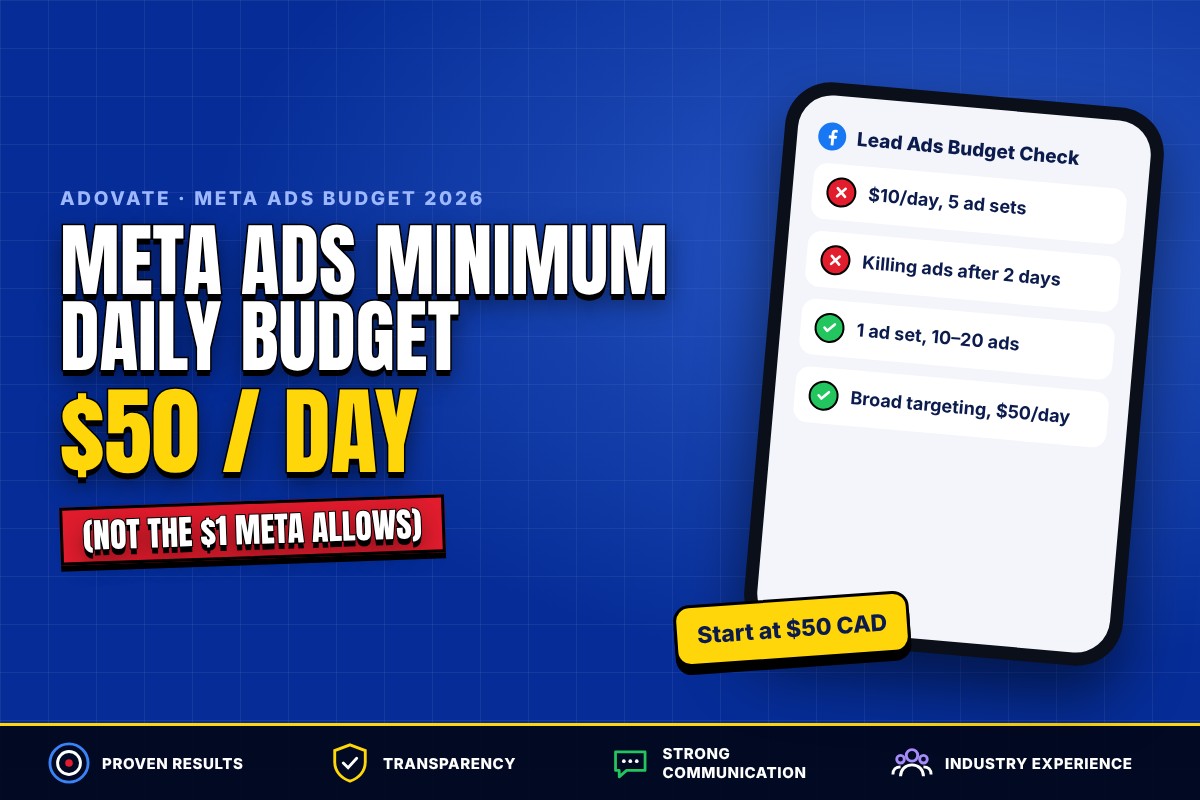
The short answer: Meta's official minimum daily budget is only a few dollars, but for service businesses running lead ads in Canada in 2026, the real minimum is about $50 CAD per day (roughly $1,500 a month). Below that, Meta doesn't get enough lead data to optimize, so you pay for the algorithm's experiments instead of for leads.
That's the number we start every Adovate client on. Here's where it comes from, how to structure the campaign, and a formula to check profitability before you spend a dollar.
What is Meta's official minimum daily budget in 2026?
Meta's technical minimum is tiny: a few dollars a day, depending on what you optimize for and your account currency.
Ads optimized for impressions can run on about $1 a day. Clicks and engagement need a few dollars a day, and conversion-type goals need more. Meta Ads Manager shows the exact floor for your currency when you set the budget, and it will warn you if you're too low.
But Meta's minimum is the least it will accept, not the least that works. A $5/day lead campaign will deliver. It just won't deliver enough results for Meta's system to learn who your buyers are.
What's the real minimum daily budget for Meta lead ads?
$50 per day is the minimum I recommend for any service business running Meta lead ads. That's about $1,500 a month in ad spend.
The number isn't magic. It sits in the range most experienced media buyers land on, and our own testing backs it up: at around $50/day, Meta can optimize for a service business at a reasonable rate. It gets enough leads, often enough, to start finding the people who actually fill out your form and pick up the phone.
Here's what that looks like in practice. One of our clients spent $1,478.93 in May 2026, right around $50 a day, and got 18 leads at $82.16 per lead. That month we cut their cost per lead by about 15%, without raising the budget, by shifting more spend onto their best-performing ad.
We don't take clients below this budget, because we know what happens below it. If you want to see how $10 a day stacks up, I broke it down in Is $10 a Day Good for Facebook Ads?
Why doesn't a small budget work for lead generation?
A small budget doesn't give Meta enough data to optimize, so your ads never reach the snowball stage.
Meta's algorithm learns from results. Every lead tells it a bit more about who converts, and the more signals it gets, the better it targets. Meta's own guideline for leaving the learning phase is roughly 50 optimization events per ad set in a week. You won't hit that on a few dollars a day, and you won't hit it at $50/day either if you split the money across five ad sets.
At $10–$20 a day, a service business might see a handful of leads a week. That's not enough signal. Delivery stays erratic, cost per lead swings, and most owners pull the plug before anything compounds.
How should you structure a $50/day Meta ads campaign?
Use one campaign and one ad set with 10–20 ads, broad targeting, and the whole budget in that one ad set. This structure is how $50 a day actually works.
- One campaign. Lead objective with Instant Forms. (If you're still on the fence about forms, here's why we use Instant Forms for almost every client.)
- One ad set. Put all $50 here. Splitting it into several ad sets means each one gets a fraction of the data and none of them learn.
- One location target. Pick the area you serve. You don't need separate ad sets for different cities or postal codes.
- No interest targeting. Leave it broad. In 2026 your creative does the targeting, and Meta finds the right people based on who responds.
- 10–20 ads in that ad set. Different hooks, formats and angles. Meta will push budget toward the winners on its own.
Then scale slowly. Once your KPIs hold steady, raise the budget gradually. With one roofing client, we raised weekly spend by up to 20% at a time rather than doubling overnight. If cost per lead stays in range, keep going. If it jumps, hold.
When should you turn off a Facebook ad?
Kill an ad once it has spent 1.5× your target cost per lead without producing a lead, but only after you've gathered enough data to know your target.
Killing ads too early is the most common budget mistake I see, along with spreading the budget across too many ad sets. Here's how we handle it:
- Gather data first. You don't know your real cost per lead in week one. Let the campaign run before you set a KPI.
- Set a CPL KPI. Say your average lands around $50 per lead. That's your benchmark.
- Use the 1.5× rule. An ad that has spent $75 (1.5 × $50) with no lead gets turned off.
- Leave low spenders alone. If an ad is only spending a buck or two a day, it isn't eating your budget, so there's no reason to kill it. Ads get very little spend at first, and some take off once Meta gives them more.
How do you calculate the right Facebook ads budget for your business?
Work backward from what a client is worth to the most you can pay per lead, then check whether your daily budget produces enough leads at that price.
You need six numbers:
- Lifetime value of a client
- Profit margin on that client
- Close rate on qualified calls
- Show rate on booked calls
- Lead-to-booked-call rate
- Daily ad spend
Here's a worked example (leaving out show rate to keep it simple):
- Lifetime value: $3,000
- Profit margin: 40%, so $1,200 profit per client
- Close rate on qualified calls: 25%, so you need 4 calls to win 1 client
- Max cost per booked call: $1,200 ÷ 4 = $300
- Lead-to-booked-call rate: 30%
- Max cost per lead: $300 × 30% = $90
- Daily ad spend: $50, or about $1,500/month
- Break-even lead volume: $1,500 ÷ $90 = about 16.7 leads per month
So in this example, you can pay up to $90 per lead and still break even on profit. Anything under that is margin. If your real cost per lead comes in at $60, you're doing well. If it's $120, you need to fix your offer, your follow-up, or your close rate.
One caveat: if you've never run Meta leads before, your close rate and lead-to-call rate are guesses. Use the formula to set expectations, then plug in real numbers after the first month. For a sense of what's normal by industry, see our cost per lead benchmarks across service industries.
Should Canadian businesses budget differently for Meta ads?
No. $50 CAD a day is still the starting point. What changes is how fast you need leads, not the floor.
We run campaigns from Winnipeg for service businesses across Canada and the US, and everyone starts at $50/day regardless of province or city.
Seasonality is what changes the budget. Snow removal is a good example: the selling season is short, so those clients spend a much larger budget in fewer months. They're not paying a higher minimum, they just need more leads faster. Work out how many leads you need per month, run them through the formula above, and size the budget to match. If you're targeting audiences across provinces, our guide to targeting Canadian audiences with Facebook ads covers the setup.
How do you scale past $50 a day?
Scale based on lead volume and lead quality. Know that doubling the budget won't always double the leads.
After the first stretch you'll see what kind of leads come in and at what cost. If you want twice the leads, start by looking at doubling the budget, but plan for something like 1.5× the leads, because cost per lead usually rises as you spend more. Keep scaling while the KPIs hold. For the bigger picture on costs, see How Much Do Meta Ads Cost in 2026?
Key takeaways
- Meta's official minimum daily budget is a few dollars, but that's what it will accept, not what works.
- For service businesses running lead ads in 2026, the real minimum is about $50 CAD/day (~$1,500/month).
- Run one campaign, one ad set, 10–20 ads, with broad targeting and a single location.
- Don't kill ads too early. Set a CPL KPI first, then cut ads that spend 1.5× your KPI without a lead.
- Use your lifetime value, margin, close rate and booking rate to work out your maximum cost per lead.
- Seasonal businesses, like snow removal, need a bigger budget over fewer months, not a higher minimum.
Frequently Asked Questions
What is the minimum daily budget for Meta ads in 2026?
Meta's technical minimum is only a few dollars a day, depending on your optimization goal and currency. Ads Manager shows the exact floor when you set your budget. For lead generation, though, most service businesses need about $50 CAD per day for Meta to optimize properly.
Is $20 a day enough for Facebook lead ads?
Usually not for a service business. At $20 a day, Meta gets too few leads to learn who your best prospects are, so cost per lead stays erratic. $20 a day can work for awareness or boosting posts, but we start lead campaigns at $50 a day.
How much should a small business in Canada spend on Facebook ads per month?
Plan on at least $1,500 CAD a month in ad spend, which is about $50 a day, for lead generation. From there, scale gradually as long as your cost per lead holds. Seasonal businesses may need more, concentrated into fewer months.
How many ad sets should I run on a $50/day budget?
One. Put the whole budget into a single ad set with broad targeting and 10–20 ads. Splitting $50 across several ad sets starves each of data and slows Meta's learning.
How do I know what cost per lead I can afford?
Multiply a client's lifetime value by your profit margin, divide by the number of calls you need to close one client, then multiply by your lead-to-booked-call rate. For example, $3,000 lifetime value at 40% margin, a 25% close rate and a 30% booking rate gives a maximum cost per lead of $90.
Want help setting the right budget?
If you're running Meta ads on a shoestring and wondering why the leads aren't coming, budget and structure are usually the first two things I'd check. Our Facebook ads management for service businesses starts every client at the budget and structure in this post, then scales based on real numbers. Book a call with Adovate and we'll run your numbers through the formula together.