Every owner wants to know if their cost per lead is "good." Most of the numbers online are scraped averages, often in US dollars, mixing ecommerce brands with dentists. So here's ours.
The short answer: On Facebook and Instagram in Canada, cost per lead depends mostly on your industry. Across our client accounts we see about $7–$11 CAD for medical clinics, $14 for home cleaning, $25–$30 for roofing, HVAC and lawn care, $18–$45 for medical aesthetics, and $67–$90 for home builders. A good CPL is whatever you can pay and still make money.
Every number below comes from our own weekly KPI tracking. That's more than 1,000 client-weeks of Meta data from July 2025 to October 2026, across 40+ accounts. Almost all of them are Canadian (most in Manitoba), so read every figure as CAD. We run all of it from Winnipeg.
What is the average Facebook ads cost per lead in Canada by industry?
Most local service businesses in our accounts land between $10 and $45 per lead. High-ticket and B2B services sit well above that. Here's the breakdown, lowest to highest, with each account's full run averaged together:
- Primary care medical clinics: $7–$11. Two Winnipeg clinics, more than 1,000 leads combined.
- Beauty and salon services: about $10. One account, 600+ leads.
- Mental health and wellness clinics: $11–$31. Three accounts.
- Spray foam and insulation: $13–$38. Three accounts.
- Home cleaning: about $14. One Winnipeg account, 2,000+ leads over 15 months. Its best months came in under $8.
- Medical aesthetics and skin clinics: $18–$45. Four accounts. The largest produced 1,400+ leads at about $45.
- Lawn care: about $25 in season. One account.
- HVAC: about $26. One Winnipeg account, 400+ leads.
- Roofing: about $27. Two Winnipeg accounts, 600+ leads combined.
- Private schools and childcare: about $34. One account.
- Snow removal: about $40. One account, 750+ leads.
- Home builders and design-build: $67–$90. Two accounts.
- Fractional CFO (B2B): about $86 on average. One account, with monthly swings from about $32 to over $500.
Two notes before you compare yourself to this list. First, these are blended averages over many months, so they include slow seasons and new-creative weeks. Second, one account isn't a law of nature. Use the ranges to tell whether you're in the right ballpark, not to grade your campaign to the dollar. For what a full month costs at these rates, including GST/HST, see what it costs to advertise on Facebook in Canada.
Why are medical clinic leads so much cheaper than everything else?
Our read: almost everyone needs a family doctor, so the offer is a basic need rather than a want, and the audience is everyone within driving distance.
This one surprised me. I expected our primary care clinics to behave like our aesthetics clients, somewhere in the $30–$45 range. Instead they're in a category of their own. One clinic in Winnipeg's Transcona neighborhood spent about $900 in September and got 107 leads at $8.43 each, with a 5.74% click-through rate. For reference, we treat 1% as the bar to beat.
The detail I'd steal: the best ad wasn't a service promotion. It was the doctor telling the story of why he started the clinic. That ad beat every ad selling a specific treatment. People choose a clinic the way they choose a person, so let them meet the person.
Does Facebook cost per lead change by city in Canada?
Less than most people think. In our accounts, CPL is far more consistent by industry than by city.
A roofer in Winnipeg and a roofer in another Canadian city will usually land closer to each other than a roofer and a cleaner in the same city. Our Winnipeg roofing accounts settled at $27–$33. Our HVAC numbers sat in the $20s through spring and summer. That pattern holds across markets we've run. Most of our work is in Canada, but what we've seen in the US looks similar.
Season and offer move CPL far more than geography does. Our snow removal client's Meta leads cost $42.73 in November 2025 and $54.56 in December, the same city a month apart. We break down that account in Facebook vs. Google Ads on the same campaigns.
Is a high cost per lead bad?
No. A high CPL is only a problem if your revenue per customer can't cover it.
Our fractional CFO client is the clearest example. Their Instant Form only accepts construction and trades companies doing more than $3 million a year. Everyone else is disqualified on the form. CPL averaged about $86 and has run well over $300 in some months. That would look like a disaster next to a cleaning company. But they aren't selling a one-time clean. They're selling ongoing CFO work to established companies, so the math is completely different, and every lead that gets through is a real prospect. They've run with us since mid-2025.
The reverse is also true. A $9 lead that never picks up the phone is the most expensive lead you'll ever buy.
What's the biggest cost per lead mistake business owners make?
Chasing the cheapest lead. It's the most common mistake we see, by far.
It always starts the same way. An owner hears that someone else is getting leads cheaper and wants that number. Nobody wants to fix the sales process, because that's the harder thing to fix. So everyone goes after cheap leads instead.
Here's the math that shows why that's backwards. Say you spend $1,200:
- Cheap leads: $12 each = 100 leads. If 10% book a call, that's 10 booked calls.
- Quality leads: $60 each = 20 leads. If 50% book a call, that's 10 booked calls.
Same spend, same number of calls, even though one CPL is five times the other. But the quality leads also close at a higher rate. And your team didn't burn a week chasing 90 people who were never going to answer. So the "expensive" leads win. Qualifying questions on your form are how you get there. Here's how we build lead forms that filter for quality.
How do you work out the maximum cost per lead you can afford?
Work backwards from what a customer is worth, through every step of your sales process.
- Revenue (or gross profit) per new customer. Include repeat business if it's reliable.
- Booking rate: what share of leads book a call or appointment.
- Show rate: what share of booked people actually show up or answer.
- Close rate: what share of those become paying customers.
- Multiply them together. Revenue × booking rate × show rate × close rate = your break-even CPL. Then decide how much margin you want to keep below it.
A quick illustration (not a client): a $2,000 job, 50% of leads book, 80% show, 30% close. That's $2,000 × 0.5 × 0.8 × 0.3 = $240 break-even CPL. A $40 lead is a bargain for that business, even if it looks "high" next to a cleaner's $14.
We don't promise a target CPL before launch. We look at the business and check whether a CPL in the range we've seen for that industry makes the math work. Then we put our best foot forward and let the data tell us. If you'd rather start from your budget instead, our guide to the minimum daily budget for Meta ads uses the same math. Once the leads are flowing, judge them on return using our ROAS benchmarks for local service businesses.
What should you do if your CPL is above your industry's range?
Fix the creative first, then the offer, then the targeting, in that order.
- Creative: most CPL problems are creative problems. The clinic example above shows it: a story ad beat every service ad.
- Offer: make it clear what someone gets by filling in the form.
- Targeting: keep it broad and let the form do the qualifying.
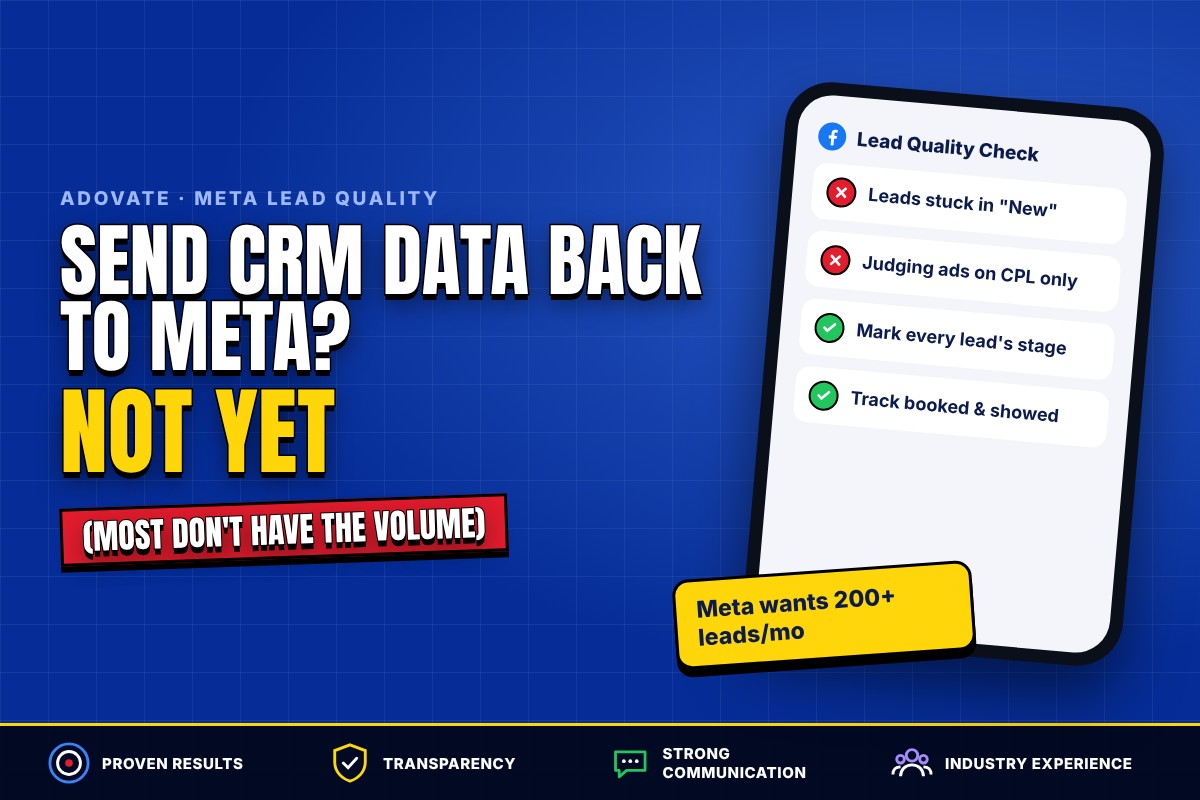
- Follow-up: if CPL is fine but nothing closes, the problem isn't the ads. Make sure every lead's outcome is marked in your CRM. We explain why in whether you should send CRM data back to Meta.
Key takeaways
- Canadian Facebook ads cost per lead ranges from about $7 (medical clinics) to $90+ (home builders and B2B) in our accounts.
- Industry drives CPL far more than city does. Season and offer come next.
- A good CPL is the one you can afford: revenue × booking rate × show rate × close rate.
- $12 leads that book at 10% and $60 leads that book at 50% produce the same number of calls for the same spend. Then the quality leads close better.
- Chasing the cheapest lead is the most common and most expensive mistake.
Frequently Asked Questions
What is a good cost per lead for Facebook ads in Canada?
For most local service businesses, $10–$45 CAD per lead is normal on Meta, depending on industry. Medical clinics and cleaning sit at the low end, while roofing and HVAC land in the high $20s. Home builders and B2B services can run $70–$100 or more and still be very profitable.
Why is my Facebook cost per lead higher than my competitor's?
Usually because of creative, offer or form questions, not budget. A form with qualifying questions will cost more per lead but filter out people who'd never buy. Compare cost per booked appointment, not just cost per lead, before deciding which campaign is actually winning.
How do I calculate my break-even cost per lead?
Multiply your revenue per new customer by your booking rate, show rate and close rate. For example, a $2,000 job with a 50% booking rate, 80% show rate and 30% close rate gives a $240 break-even CPL. Stay comfortably below that number and the campaign is profitable.
Are Facebook leads cheaper in smaller Canadian cities?
Not by as much as most people expect. In our accounts, CPL varies far more by industry than by city, so a roofer in Winnipeg and a roofer elsewhere in Canada usually land in a similar range. Seasonality and the strength of your offer move the number more than location does.
Should I lower my cost per lead by removing form questions?
Usually not. Removing qualifying questions makes leads cheaper but books fewer of them. If cheap leads book at 10% and qualified leads book at 50%, the qualified leads can cost five times more and still produce the same number of calls.
Want to know what your cost per lead should be?
We'll run your numbers backwards from revenue and tell you, honestly, whether Meta ads make sense for your business and what range to expect. See our Facebook ads management for service businesses, or book a free strategy call.