
February 10, 2026
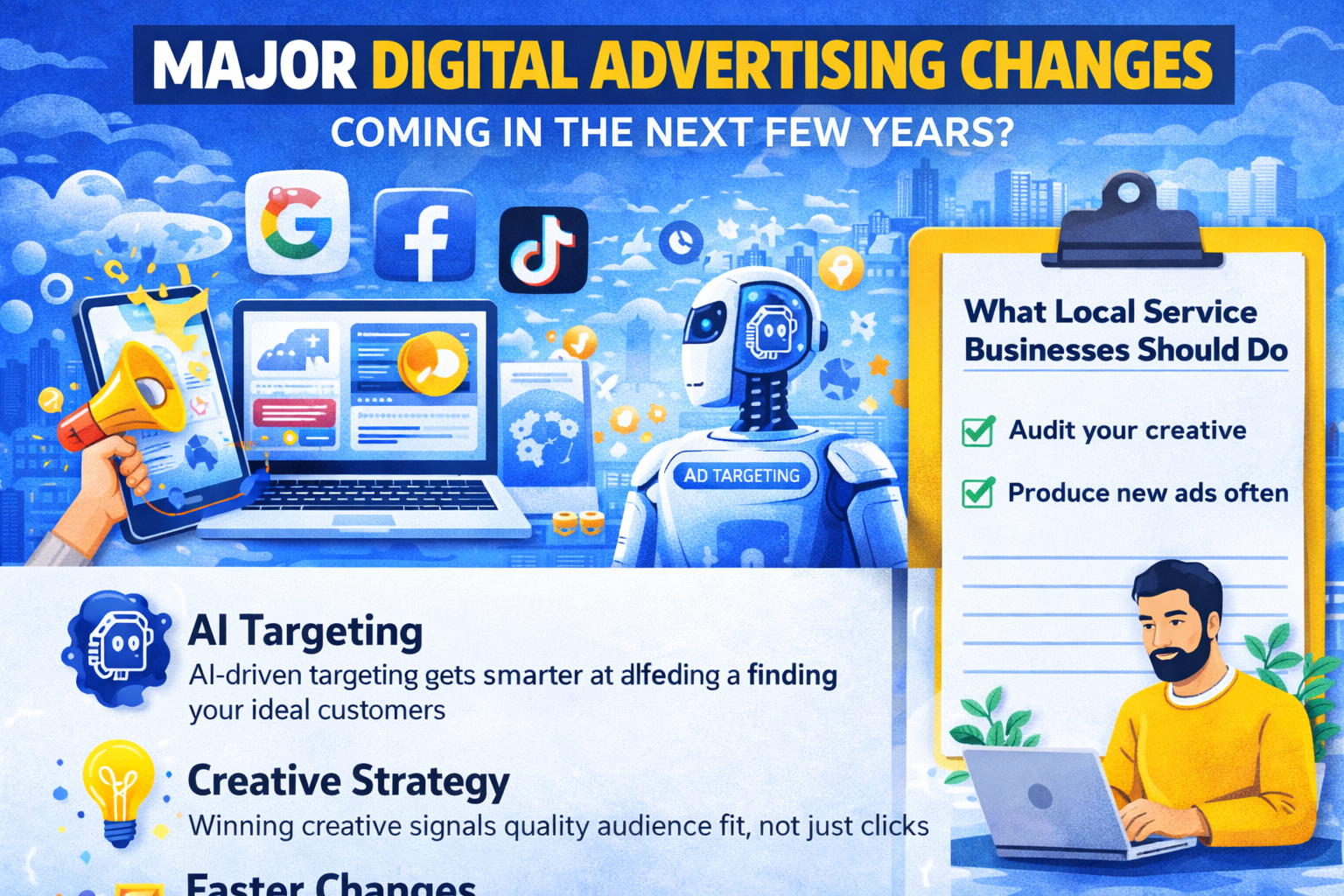
A practical breakdown for local service businesses
If you run a local service business and rely on paid ads to generate leads, the next few years will feel very different from the last five.
The biggest change isn’t a new platform. It’s a fundamental shift in how platforms decide who sees your ads — and what actually drives results.
After managing campaigns for local service businesses and watching performance evolve closely, here are the major changes I believe will define digital advertising over the next few years — and what they mean for you.
1. Targeting Will Get Broader — Because AI Is Getting Smarter
For years, advertisers obsessed over detailed targeting: interests, behaviors, lookalikes, layering audiences, narrowing audiences. That approach is fading.
Platforms — especially Meta — are investing heavily in AI systems that determine who should see your ad based on signals from your creative, conversion data, and behavioral patterns. We’ve already seen this shift in action.
In many of our campaigns today, broad targeting performs as well or better than narrow targeting — as long as the creative clearly speaks to the right audience.
What this means for local businesses
You don’t need to “hack” targeting anymore. Instead:
- Your creative tells the algorithm who the ad is for
- The algorithm finds people who behave like responders
- Better signals = better matching = better leads
The future of targeting is not manual control — it’s signal quality.
2. Creative Will Become the #1 Performance Lever
The most important shift happening right now: creative is replacing targeting as the primary driver of results.
Your ad doesn’t just impact click-through rate. It influences:
- Who the algorithm shows your ad to
- The quality of leads you receive
- Conversion intent
- Cost per lead
In other words:
Weak creative → cheap but low-quality leads
Strong, specific creative → higher-quality leads + better performance
We see this constantly in real campaigns. When an ad clearly speaks to a specific type of customer — using their language, objections, and motivations — the platform becomes far more efficient at finding the right people.
The skill that will separate winners from losers
Not media buying. Not targeting tricks.
Creative strategy.
Businesses that deeply understand:
- Their customer
- Their objections
- Their motivations
- What messaging resonates
…will dominate.
3. Traditional A/B Testing Is Dying
Many businesses still “test hooks” by swapping the first few seconds of an ad while everything else stays the same.
This approach is becoming less effective.
From the platform’s perspective, many of these ads are too similar, so the system doesn’t treat them as meaningfully different inputs. You end up learning less than you think.
What works better now: Concept Testing
Instead of tiny variations, test different ideas, such as:
- Different angles (price vs quality vs speed vs trust)
- Different formats (talking head, proof, walkthrough, story)
- Different positioning (budget vs premium vs specialist)
- Different proof (reviews, process, results, guarantee)
We’ve found this produces clearer signals, faster learning, and stronger winners.
4. Creative Production Speed Will Become a Competitive Advantage
Another major shift we’ve seen firsthand:
- Bad ads fatigue faster than before
- But winning ads can last a long time
This changes how campaigns should be run.
The winning structure now looks like:
- Launch with multiple creatives early
- Quickly identify winners
- Let winners scale
- Replace underperformers fast
In practice, the biggest constraint in campaigns today is not targeting — it’s creative production.
This is why many ad agencies are evolving into creative-first performance agencies. The bottleneck is no longer buying media. It’s producing effective ads consistently.
5. AI Will Start Helping Create Ads — Not Just Deliver Them
AI is not only improving targeting. It’s beginning to change how ads are produced.
Over the next few years, platforms and tools will increasingly help generate:
- Ad variations
- Visual assets
- Video formats
- Copy and messaging options
This will dramatically lower the barrier to producing content — especially for local service businesses.
However, AI cannot replace market understanding.
The businesses that win will still be the ones who understand:
- Who their best customer really is
- What objections stop them from buying
- What builds trust quickly
- What makes them act now
AI can scale execution. It cannot replace strategy.
6. What Will Become Harder
Based on current trends, here’s what will get more difficult over the next few years:
- Keeping up with consistent creative production
- Standing out as more advertisers improve their content
- Generating strong signals with weak messaging
- Competing without clear positioning
Businesses that treat ads like a “set and forget” system will struggle.
7. What Will Become Easier
On the positive side:
- Platforms will get better at finding the right audience automatically
- Broad targeting will become more reliable
- Learning phases will improve
- Optimization will require less manual intervention
In short: execution becomes easier, strategy becomes more important.
What Local Service Businesses Should Do Now
If you want to stay ahead of these changes, focus here:
1. Shift your mindset
Stop thinking:
“Who should I target?”
Start thinking:
“Does my ad clearly signal who this is for?”
2. Build a simple creative system
Your ads should consistently cover:
- The problem your customer has
- Their biggest objection
- Proof you can deliver
- Your process
- A clear reason to act now
3. Test ideas, not tiny edits
Run multiple distinct concepts, not minor variations.
4. Invest more time into creative
The businesses that win in the next few years won’t be the best at targeting.
They’ll be the best at communicating.
Tired of running ads yourself? See how we can help
Final Thought
Digital advertising platforms are not becoming harder — they’re becoming different.
The future belongs to businesses that:
- Understand their customer deeply
- Communicate clearly through creative
- Adapt quickly
- Use AI as leverage, not a crutch
If you treat creative as the core of your marketing — not an afterthought — you won’t just keep up with the changes.
You’ll benefit from them.
Adam Fishkin
February 10, 2026
Other blogs
What's happening
Our latest news and trending topics


